
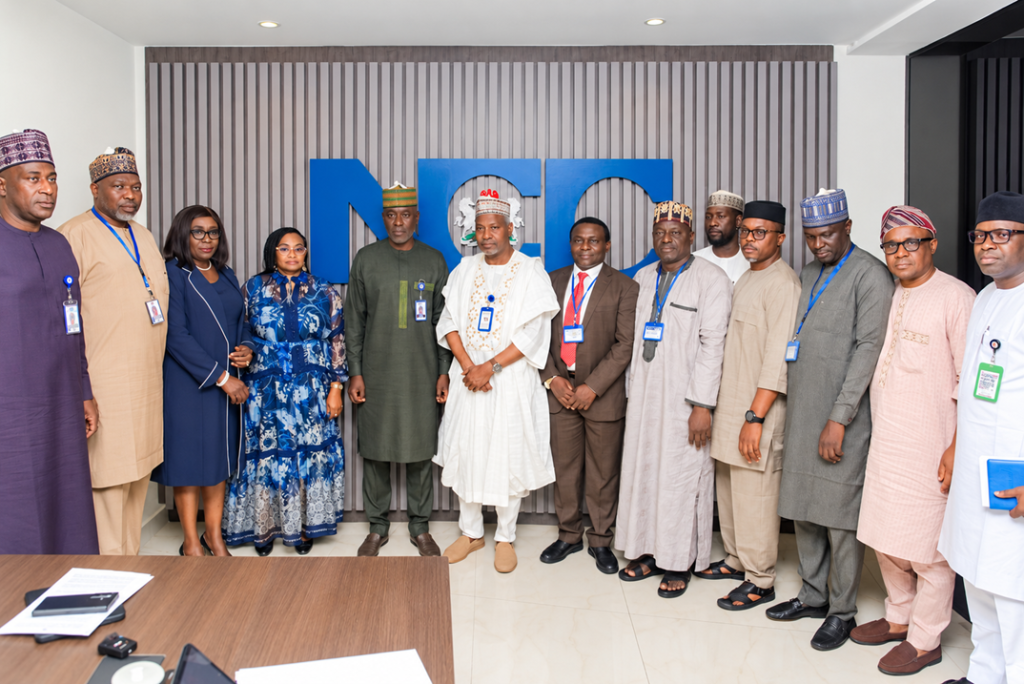
The Executive Secretary of the National Universities Commission (NUC), Professor Abdullahi Yusufu Ribadu, FCVSN, on Wednesday, 7 October 2026, led members of the Commission’s Management on a courtesy visit to the Nigerian Communications Commission (NCC), Abuja, where they were received by the Executive Vice-Chairman (EVC), Dr. Aminu Maida, and members of his Management team.
Speaking during the visit, Professor Ribadu thanked the EVC and NCC Management for the warm reception and the Commission’s sustained support for the Nigerian University System (NUS). He noted that the longstanding collaboration between the two agencies demonstrated the importance of inter-agency partnerships in advancing national development.
The Executive Secretary acknowledged the NCC’s contributions through the Universal Service Provision Fund (USPF) towards improving digital connectivity and ICT infrastructure across the university system, particularly in institutions facing significant barriers to access. He said these interventions had strengthened the digital foundation for teaching, learning, research, administration and innovation.
On digital transformation and artificial intelligence (AI) in the NUS, Professor Ribadu observed that emerging technologies, including AI, cloud computing, data analytics and cybersecurity, were transforming education, research and institutional administration. He stressed that universities must not only adopt these technologies but also develop the capacity to govern and deploy them responsibly and harness their potential for innovation.
He disclosed that the NUC had developed an Artificial Intelligence Policy Framework for implementation across the university system, with implementation already commencing. According to him, the framework provides an institutional and regulatory foundation for the responsible application of AI in teaching and learning, assessment, research, innovation and university administration. He emphasised, however, that successful implementation would require adequate digital infrastructure, cybersecurity, data protection, appropriate governance arrangements, human capacity and institutional readiness.
Addressing the need to strengthen the NUC’s regulatory capacity, Professor Ribadu explained that effective digital transformation and AI integration across the university system required coordinated efforts involving the NUC, NCC and other relevant stakeholders. He noted that the NCC was particularly well positioned to support the initiative through its regulatory mandate, industry leadership and USPF intervention framework.
The Executive Secretary stressed that the Commission also needed to strengthen its internal digital capacity to effectively monitor and evaluate digital transformation, AI readiness, cybersecurity, data governance and technology-enabled quality assurance across the 328 universities in Nigeria. He said this required a robust and secure ICT environment capable of supporting evidence-based regulation.
He further explained that the NUC was taking deliberate steps to upgrade its network infrastructure, computing and end-user devices, cybersecurity capabilities, enterprise systems and ICT human capacity. He highlighted the deployment of the eNUC Portal as part of efforts to enhance digital monitoring, data-driven quality assurance, AI readiness assessment, regulatory reporting and evidence-based oversight of Nigerian universities.
Consequently, Professor Ribadu sought the NCC’s partnership and support for the modernisation and upgrading of the NUC’s ICT infrastructure. The priority areas identified included modern and secure enterprise network infrastructure, comprising high-capacity switching, wireless connectivity, structured cabling, fibre infrastructure, network management systems, access control, security monitoring and threat-management capabilities.
Other areas included modern computing and end-user devices to support contemporary enterprise applications and digital regulatory systems; capacity development for NUC personnel in emerging technologies, cybersecurity, cloud computing, AI, network management and data governance; and technical partnership and knowledge transfer to enable the Commission to benefit from the NCC’s expertise in digital infrastructure deployment and management.
The Executive Secretary disclosed that the NUC already had an established network development plan and corresponding cost estimates for the proposed upgrade. He expressed the Commission’s readiness to work with the NCC to review and validate the plan and explore opportunities for supporting its implementation.
He emphasised that strengthening the NUC’s digital capacity would have benefits extending beyond the Commission, as it would enhance its ability to oversee digital transformation across the university system, promote responsible AI adoption, improve technology-enabled quality assurance and provide effective, evidence-based regulatory oversight. Such support, he added, would ultimately help universities produce graduates equipped with the knowledge and skills required for the digital economy.
Professor Ribadu reiterated the NUC’s commitment to its partnership with the NCC and expressed the hope that the Commission would favourably consider the proposed areas of support. He also called for continued collaboration towards building a stronger, more secure and digitally capable regulatory environment for the Nigerian University System.
In his response, the EVC, Dr. Aminu Maida, thanked the NUC delegation for the visit, noting that it would further strengthen the longstanding relationship between the two agencies. He acknowledged the enormous responsibilities of the NUC in regulating 328 universities and ensuring academic stability and effective administration across the university system.
Dr. Maida assured the Executive Secretary that the NCC would critically examine the NUC’s proposal with a view to providing appropriate support and interventions in line with its mandate. He also affirmed the commitment of both agencies to working together towards achieving the objectives of President Bola Ahmed Tinubu’s Renewed Hope Agenda.
During the interactive session, members of the NCC Management disclosed that the Commission had implemented several digital development interventions across Nigerian universities over the past five years, with 82 universities benefiting from various projects. They added that 65 universities had benefited from the NCC’s e-Pact initiative, while some teaching hospitals had received support through its e-health project, among other interventions.
In his remarks, the Deputy Director of ICT, Mr. Anthony Adejumo, noted that the NUC, as the regulatory agency for the Nigerian University System, was responsible for providing oversight to ensure the smooth running of academic and administrative activities and the stability of the system. He commended the positive impact of the NCC’s digital interventions on universities and appealed for similar support to be extended to the NUC to strengthen and complement its digitalisation efforts. Members of the NUC Management who accompanied the Executive Secretary included the Director of Accreditation, Engr. Abraham Chundusu; Director of Establishment of Private Universities, Mal. Ashafa Ladan; Acting Director, Executive Secretary’s Office, Mr. Adewale Bakare; Acting Director of Academic Planning, Dr. Ayuba M. Dauda; and Deputy Director of ICT, Mr. Anthony Adejumo, among others.