
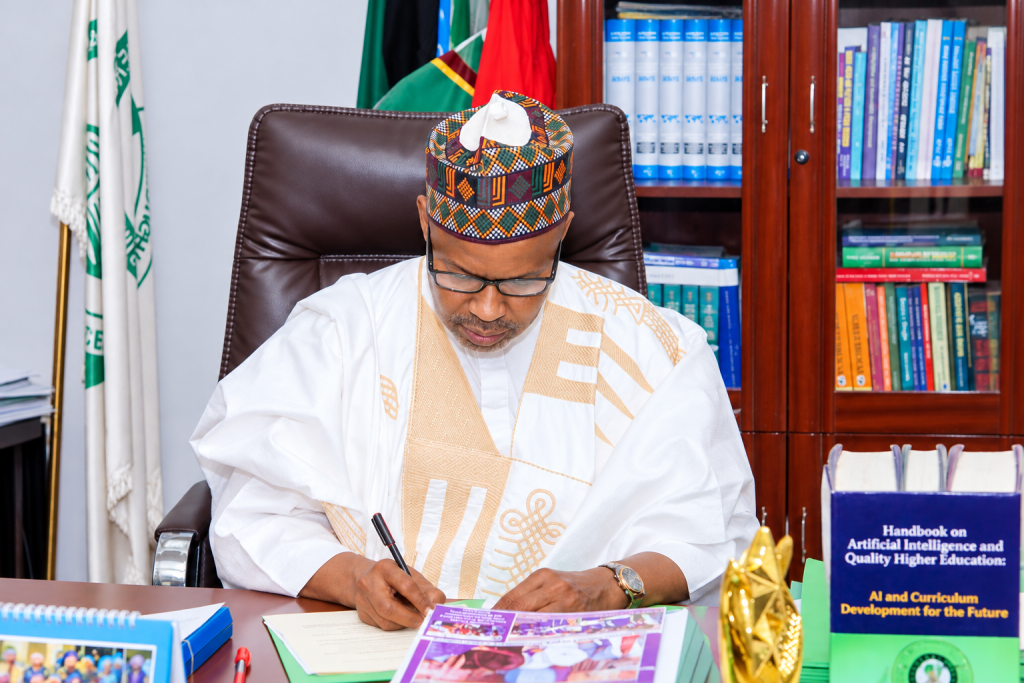
The Executive Secretary, National Universities Commission (NUC), Professor Abdullahi Yusufu Ribadu, FCVSN, on Thursday, 24th September, 2026, tasked the Committee on the Development of the National Guidelines on Micro-Credentials in Nigeria, to recognize that Micro-credentials are not envisaged as replacements for degree programmes, but as flexible learning pathways that can enhance access, support skills development, and strengthen the linkage between higher education and the world of work.
He gave the charge while flagging-off the two day-critical committee meeting on the draft guidelines organized by NUC in collaboration with the Commonwealth of Learning (COL), held at the New Boardroom, NUC, Abuja.
The meeting was convened to review the draft document on National Micro credentials targeted towards modernizing and transforming University Education in Nigeria and represents Nigeria’s architectural blueprint, as the Framework if properly articulated will serve as the engine room.
Professor Ribadu recalled that stakeholders gathered some few months ago, as a collective body of visionaries, academics, industry leaders, and policy experts, to successfully formulate and adopt the National Micro-Credentials Framework for Nigeria.
He stated that this foundational document established the stakeholders shared national vision, to create flexible, quality-assured, and globally competitive pathways for lifelong learning, skill acquisition, and up-skilling within the nation’s tertiary education sector.
He further stressed that with the framework in place, the next decisive step and objective is to translate those strategic principles into actionable, seamless operational realities.
The Executive Secretary noted that achieving the objective will provide the university administrators, industry partners and stakeholders with clear, and standardized rules on issues related to Quality Assurance & Accreditation, Credit Value & Stack ability, Industry Collaboration & Relevance, Governance & Digital Infrastructure, with the rapid evolution of the global workforce that demands agility. While appreciating everyone who had worked tirelessly in developing the draft framework including the COL, Pilot institutions, technical working groups and NUC staff, he encouraged frank, constructive, and policy-focused deliberations, guided by the shared commitment to quality education, skills relevance, and national development.
The Vice-Chancellor, National Open University of Nigeria, Prof. Udume Oji Uduma, represented by Prof. Emeka C. Ogoko mentioned that the committee was established to advance the development of the collaborative draft National Guidelines on Micro-Credentials in Nigeriawhich will help in ensuring quality in the complementary mechanism for delivering short-cycle,outcomes-based learningaligned with specific skills and competencies.
While suing for caution, the Vice-Chancellor of Ladoke Akintola University of Technology (LAUTECH), Prof. Razaq Olatunde Rom Kalilu ably represented by Dr. Mary Abosede Adeoye highlighted that for Nigeria, the development of the draft National Guidelines on Micro-Credentials need to be carefully guided to ensure alignment with the National Micro-Credentials Framework for Nigeriaand National Policy on Education.
It must also be in coherence with existing qualification structures, and consistent with the regulatory oversight responsibilities of the NUC.
While giving an overview of the Background and Rationale for the Development of the National Guidelines on Micro-Credentials in Nigeria, the NUC Director, Open, Distance and e-Learning (DODel), Dr. Funmilayo Morebise highlighted that the rapid transformation of the labour market, emerging technologies and changing skills requirements have increased the need for flexible, competency-based and lifelong learning opportunities within the Nigerian higher education system.
She stated that Micro-credentials provide a means of recognizing specific knowledge, skills and competencies acquired through short, focused and outcome-oriented learning.
Dr. Morebise recounted that in response to these developments, the NUC in collaboration with the COL developed the National Micro-Credentials Framework for Nigeria.
She explained that the Framework establishes the national foundation for the definition, recognition, quality assurance, credit structure, assessment, digital credentialing, credit transfer, stackability and implementation of micro-credentials.
Harping on the rationale for the guidelines, the Director pointed out that it was developed among others, to:
- Translate the National Micro-Credentials Framework into practical institutional requirements and procedures for Nigerian universities;
- Promote consistency and quality assurance in the design, approval, delivery, assessment and certification of micro-credentials;
- Strengthen alignment of micro-credentials with labour-market, industry, professional and societal needs; and
- Protect learner interests, institutional integrity and public confidence through transparent information, quality assurance and appropriate regulatory oversight.
She explained that the overall objective of the guideline is to provide a coherent, quality-assured and nationally responsive implementation mechanism through which Nigerian universities can effectively operationalize the National Micro-Credentials Framework and expand opportunities for flexible, competency-based, industry and lifelong learning. The high-point was the presentation of the draft guidelines on Micro Credentials in Nigeria for critical review by the Committee aimed at serving asa Guide for Institutional Adoption, Design, Quality Assurance, Recognition and Implementation Bridging Skills Gaps, relevant Enhancing Employability, and Facilitating Recognition and Mobility within the Nigerian University System (NUS).