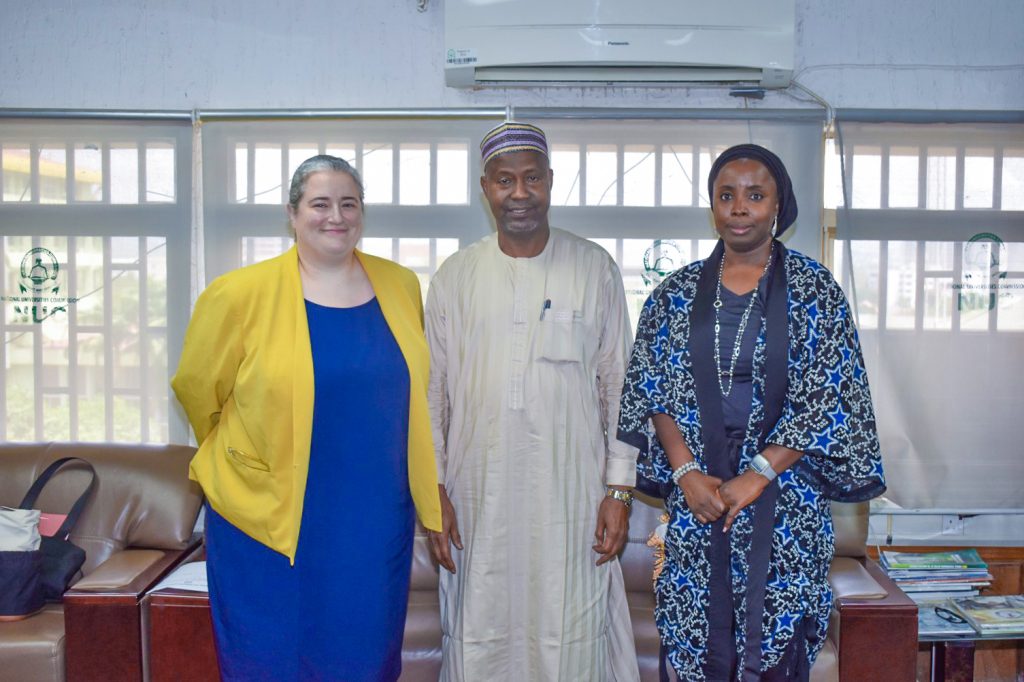
A delegation from the United States Embassy, comprising the Cultural Attaché in Nigeria, Ms. Raisa Duncas, and Education Specialist, Ms. Shade Adebayo, on Monday, 16th March, 2026, paid a courtesy visit to the Executive Secretary of the National Universities Commission (NUC), Professor Abdullahi Yusufu Ribadu, FCVSN, in his office.
The purpose of the visit was twofold: to seek the Commission’s intervention in the recognition and placement of holders of United States High School Diplomas on parity with the Senior School Certificate Examination (SSCE) or its equivalent within the Nigerian education system for the purpose of admission into universities; and to explore avenues for partnership with leading United States institutions in advancing Artificial Intelligence (AI) policy development in Nigerian universities.
In her remarks, the leader of the delegation, Ms. Duncas, expressed concern over the non-recognition of American High School Diploma credentials by Nigerian institutions, whether obtained within Nigeria or abroad. She noted that, in contrast, universities in the United States readily recognise Nigerian qualifications, reflecting the high regard for the country’s academic standards.
She emphasized the need for reciprocity in admission considerations between both countries, particularly for American-trained students, including expatriate children residing in Nigeria. She further commended the strong academic performance of Nigerian students in American high schools and colleges, disclosing that they contribute over $800 million annually to the United States education system.
Ms. Duncas also highlighted concerns regarding the requirement for holders of American High School Diplomas to obtain additional qualifications such as those issued by West African Examinations Council (WAEC), National Examinations Council (NECO), or National Business and Technical Examinations Board (NABTEB), before being eligible to sit for the Post-Unified Tertiary Matriculation Examination (Post-UTME) conducted by the Joint Admissions and Matriculation Board (JAMB). She noted that this requirement has been a source of concern, hence the need for engagement with the Commission.
On the issue of Artificial Intelligence policy, she sought to understand the Commission’s efforts at standardising AI-related policies to support implementation within the Nigerian university system. She also advocated for closer collaboration between both parties in identifying areas of partnership to enhance the deployment of AI in teaching and learning.
In his response, the Executive Secretary, Professor Ribadu, acknowledged the concerns raised, explaining that the American High School Diploma is not currently recognised within Nigeria’s qualification framework largely due to its nomenclature, which is not yet formally captured within the country’s regulatory system. He noted that such recognition falls under the purview of the National Council on Education (NCE), chaired by the Honourable Minister of Education, as the highest decision-making body on education policy in Nigeria.
He further explained that for any qualification to be officially recognised in Nigeria, it must be approved by the Council, after which relevant bodies such as the Joint Admissions and Matriculation Board (JAMB) and the National Board for Technical Education (NBTE) can integrate it into their respective admission and regulatory frameworks.
Professor Ribadu further explained that the challenge largely stems from differences in curriculum, noting that alignment is often easier with institutions in the United Kingdom due to similarities in academic structure and learning content.
Despite this, he assured the delegation that a viable pathway would be the development of a comprehensive concept memo to facilitate the recognition and adoption of the American High School Diploma as a qualifying examination, comparable to those offered by the West African Examinations Council (WAEC) and the National Examinations Council (NECO).
He added that, alternatively, the qualification could be positioned as a higher-level credential eligible for Direct Entry admission through the Joint Admissions and Matriculation Board (JAMB), subject to its approval by the National Council on Education (NCE), thereby eliminating the need for candidates to undertake additional examinations.
The Executive Secretary emphasised that whichever pathway is adopted, extensive stakeholder consultation and engagement would be required, particularly involving the Federal Ministry of Education (FME) and JAMB, to properly evaluate and determine the appropriate qualification framework.
On the issue of Artificial Intelligence (AI) integration, Professor Ribadu disclosed that the Commission had already established a partnership with DIMLAS Corporation, a United States-based firm, which has trained a number of Nigerian academics on the application of AI tools within universities. He further noted that the Commission is at an advanced stage of finalising its AI policy for the Nigerian University System (NUS), while remaining open to additional collaborations that would strengthen its effective domestication.
The delegation from the United States Embassy expressed willingness to continue consultations with key stakeholders, including JAMB and the Federal Ministry of Education (FME), to secure the necessary buy-in for the proposed initiatives.
Also in attendance were Directors of the National Universities Commission, including Academic Planning (DAP), Mr. Mohammed Abubakar Girei; Accreditation (DA), Engr. Abraham Chundusu; and Public Affairs (DPA), Mrs. Rita N. Okonjo, as well as the Acting Director, Executive Secretary’s Office (DESO), Mr. Adewale Bakare.The Director, Research, Innovations and Information Technology (DRIIT), Malam Mohammed Lawal Faruk, was represented by the Deputy Director, Innovations, Mr. Patrick Ukah. Also present were the Deputy Director, Legal Services, Barr. Pascal Eruaga, and the Head of Special Duties in the Executive Secretary’s Office, Dr. Abubakar Tanko Mohammed.