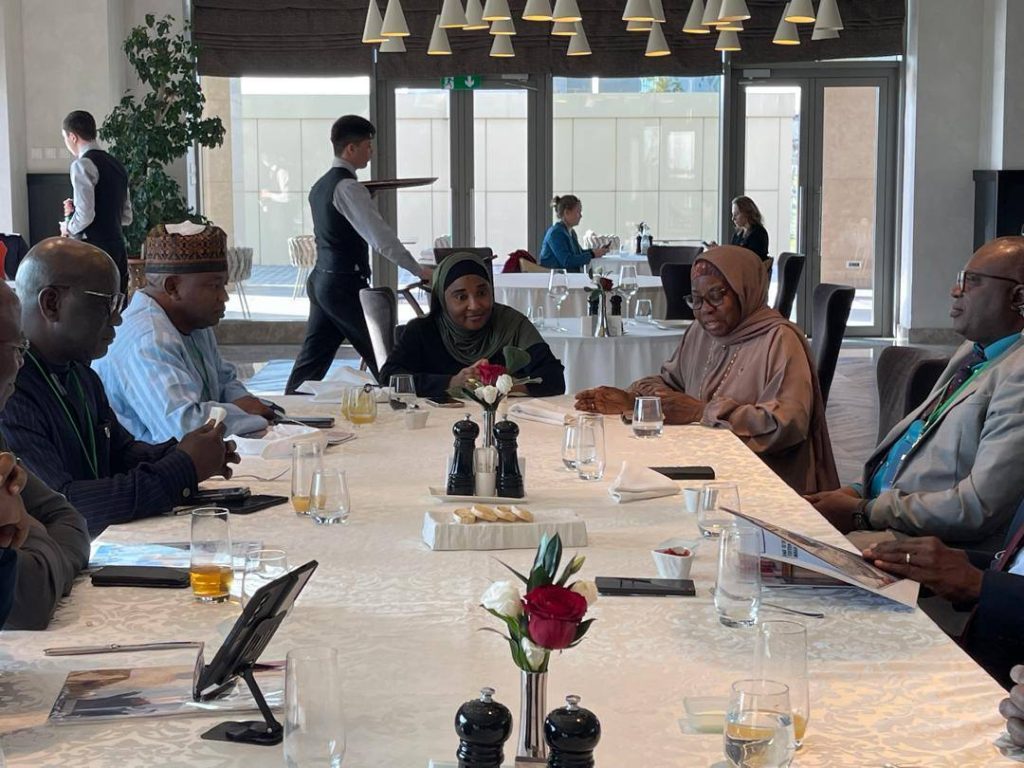
The Honourable Minister of State for Education (HMSE), Professor Suwaiba Sa’id Ahmad, led a delegation from Nigeria that included the Executive Secretary, National Universities Commission (NUC), Professor Abdullahi Yusufu Ribadu, FCVSN, to the 43rd Session of the United Nations, Education, Scientific and Cultural Organisation (UNESCO) General Conference, which took place at Samarkand, Uzbekistan and provided a platform for the country to advance its educational priorities on the global stage.
Other delegates to the Conference were the Chairman, Senate Committee on Tertiary Education and TetFund, Senator Muntari Danduste, the Secretary-General of the Nigerian National Commission for UNESCO, Dr. Olagunju Idowu, some officials of State Ministries of Education and the Executive Secretary, NUC, was accompanied by the Acting Head, Special Duties, Dr. Abubakar Tanko Mohammed.
The opening session also witnessed the participation of the President of Uzbekistan, His Excellency, Mr. Shavkat Mirziyoyev; President of Serbia, His Excellency, Mr. Aleksandar Vučić; the President of Slovakia, His Excellency, Mr. Peter Pellegrini and representatives of UNESCO Member States.
Reports emanating from the event centre indicates that Nigeria’s participation was anchored on the renewed focus on Sustainable Development Goal 4 (SDG 4) which promotes inclusive, equitable and quality education for all.
Through high-level engagements and bilateral meetings, Nigeria delegation shared their experiences, sought meaningful collaborations to help address its challenges and learnt from international best practices that can strengthen its education system.
Through engagements with other participating countries, Nigeria also sought to strengthen cooperation with UNESCO and mobilise greater support for national initiatives that will contribute to the development of a stronger educational framework.
At the opening ceremony, UNESCO’s Director-General, Mr. Audrey Azoulay kick-started the general policy debate with a recount of 8 years of action, taking the history of the Silk Road as a symbol of culture and knowledge reflecting UNESCO’s mandate.
She underlined UNESCO’s role and contribution to international cooperation in world fractured by crisis, highlighting that he took the position of Director-General of UNESCO eight years ago, with the conviction that its mission had lost none of its relevance or timeliness.
She said this may be the only mandate around which the world can still come together as an international community in words and actions.
The Director General further highlighted that during her 8-year term, UNESCO had increased its resources by nearly 800 million dollars, a growth of 82 percent.
She attributed the financial renaissance to a strategic reorganization where UNESCO took “concrete action on the ground.”
Over recent years, UNESCO has undergone a transformation to react in crisis zones and in their aftermath. This repositioning led to the organization taking on big projects such as the “Revive the Spirit of Mosul” initiative, which proved that culture plays an essential role in post-conflict reconstruction and the promotion of peace.
According to him, UNESCO is currently supporting education in Ukraine, Yemen and Gaza. The Director General announced a new initiative in Syria for the rehabilitation of the Aleppo Museum.
The President of Uzbekistan, Mr. Shavkat Mirziyoyev, addressed the delegates as the host country of the Conference. He welcomed everyone to Samarkand “a city that has made it into human history as a center of humanistic ideas, unique knowledge and inter-civilizational dialogue”.
The gap is widening among States in access to knowledge, technologies, and digital resources, while deepening inequality and poverty. Such complex circumstances dictate us to unite our efforts more than ever to fully implement UNESCO’s main objectives, he said.
He also highlighted a number of initiatives by Uzbekistan to deepen the cooperation with UNESCO to a new level, developing inclusive education for every child, through a UNESCO platform for the development of Inclusive Education and the implementation of a “School of Artificial intelligence” model project. The President also expressed Uzbekistan’s interest to strengthen UNESCO’s Memory of the World Programme and adopt a new international day on this theme.
He suggested the creation of a UNESCO Academy on Women’s leadership, a new Network of UNESCO cities to combat climate change as well as a new programme to counter misinformation and promote mutual understanding in the digital age. The opening ceremony closed in a grand style with the celebration of culture, as the renowned Jonas Kaufmann (Opera Tenor) and Hélène Mercier (Piano), and the National Symphony Orchestra of Uzbekistan playing a selection of classical music.