
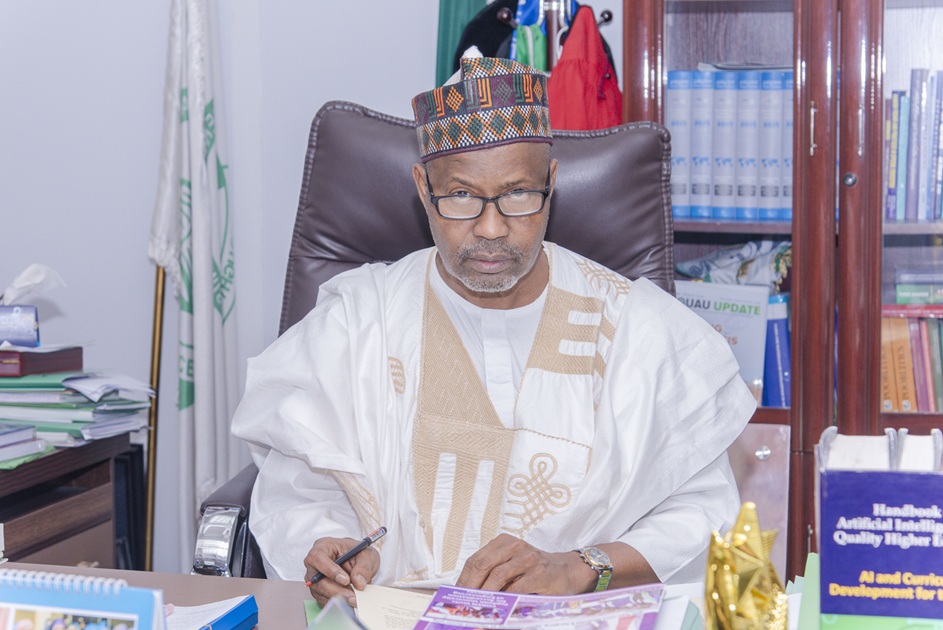
The Executive Secretary, National Universities Commission (NUC), Professor Abdullahi Yusufu Ribadu, FCVSN, has reaffirmed his commitment towards transforming the Nigerian University System (NUS) in the year 2026, in order to leverage on the gains and achievements recorded in the out gone year 2025.
In the usual New Year message, Professor Ribadu recalled that he outlined a seven-point cardinal agenda that will guide him in his roadmap for the NUC-NUS when he assumed duties last December 2024, emphasizing that his administration would remain focused on these set objectives, aimed at reforming and repositioning the system in the best interest of the nation.
He used the medium to express profound gratitude to God for the Grace to lead the system at this point in time, and to the President and Commander-in-Chief, Armed Forces of the Federal Republic of Nigeria, Asiwaju Bola Ahmed Tinubu, GCFR, for his appointment; the Honourable Minister of Education (HME) and the Minister of State for Education (HMSE), Dr. Maruf Tunji Alausa and Professor Suwaiba Said Ahmad, respectively; the newly inaugurated 13th Board of the Commission, the entire NUS as well as management and staff of the NUC for the support extended to him.
All these dramatis personae, he acknowledged had contributed significantly to the progress recorded, describing the success as a collective effort of every single individual aforementioned.
Professor Ribadu stressed that the roadmap was designed in tune with the Renewed Hope Agenda of President Tinubu geared towards delivering competitive higher education to the Nigerian teeming youths, in order for them to be relevant on the global stage.
The Executive Secretary highlighted the seven point strategic goals which will guide his tenure and scorecard after five years as follows: Increasing Access, Enhancing Funding and External Support, Driving Digitisation, Strengthening Quality Assurance, Promoting Innovation and Research, Stabilising the Academic Calendar and Revisiting NUC Laws.
Explaining further on the Key Performance Indicators (KPIs) and deliverables based on each goals set, he highlighted that towards increasing access and balance, the NUC under his watch in 2025, had expanded the number of Public Universities with the addition of seven new Federal institutions established by the Federal Executive Council (FEC), namely: Federal University of Environment and Technology, Tai Town, Ogoniland, Rivers State; Federal University of Applied Sciences, Kachia, Kaduna State formerly Nok University, Kachia); Tai Solarin Federal University of Education, Ijagun, Ijebu-Ode, Taken over from Ogun State); Federal University of Agriculture and Development Studies, Iragbuji, Osun State, Federal University of Technology and Environmental Sciences, Iyin-Ekiti, Ekiti State; Federal University of Agriculture and Technology , Okeho, Oyo State and Federal University of Health Sciences and Technology, Tsafe, Zamfara State.
He added that there are six new state universities in place, while private universities has increased by 20, within the period, highlighting that these developments would be sustained in the new year with more rigorous regulatory engagements, in order to maintain quality and global standards.
The Commission attained a landmark achievement with the approval of the first ever Branch Campus, Lincoln University College, Malaysia, Kumo Branch Campus, Gombe State- under the Trans-National Education (TNE) universities programme in Nigeria and the addition of two new Distance Learning Centres across the country, bringing the total now to 36 degree awarding distance learning institutions( the National Open University of Nigeria, NOUN), four new private open universities and 31 dual mode universities), to promote blended learning mode in the NUS.
In the area of Quality Assurance and ensuring standards in the NUS, the Commission has consistently and successfully conducted the routine October/ November 2025 accreditation of old programmes and Resource verification for new programmes to ensure that the requisite manpower and material resources in the universities were in line with laid down academic standards.
Giving details of the resource verification exercise, he disclosed that 879 new programmes were introduced in the Nigerian Universities in the outgone year 2025 based on the recently approved Core Curriculum Minimum Academic Standards (CCMAS), while similar accreditation exercises were conducted on the various Affiliates Institutions as well as Distance Learning Centres whose approved courses, are due for visits within the year under review and these exercises had now been structured towards standardization of Nigerian Universities for global competitiveness.
The Commission had also sustained its implementation of a new phase of quality assurance by embarking on Transnational Education (TNE) Quality Assurance in Nigerian universities, Assessment of Status of Students Support Facilities and Services in Nigerian universities, Monitoring of selected State Universities in the six geopolitical region, evaluating the quality of governance and management practices in Nigerian universities, Assessment and Verification Visit to Universities’ Entrepreneurship Development Centres (EDCs), Students Industry Work Experience Scheme (SIWES) and University-industry Linkages (UiL) Offices as well as Mapping and Conducting Labour Market Survey to Determine Requisite Industrial Skills.
To ensure professionalism and increased marketable of faculty and students in the NUS in line with global trend and best practices, the Commission with the recently released four major documents on TNE had continued to promote it in Nigeria, following massification and internationalisation of university education namely, (i) Guidelines on Transnational Education in Nigeria (TNE), (ii) Guidelines for Establishment of Private Open Universities in Nigeria, (iii) Guidelines on e-Learning in Nigeria and (iv) Guidelines on the Implementation of Open Educational Resources (OER) in Nigerian Universities.
The Commission has continued to collaborate with the University of Sussex, United Kingdom in organising professional development courses for Nigerian faculty. The intensive training was aimed at improving the pedagogical knowledge, skills and competence of Nigerian academics in line with contemporary competitive Higher education sector review.
The Commission has also in partnership with University of London (UoL) embarked on developing strategies towards expanding capacity on widening access to Open and Distance Learning (ODL) to meet the increasing demand for university education in Nigeria as well as assuring quality in ODL.
On the Goal of Enhancing Funding and External Support, Professor Ribadu noted that NUC had made effort through its Blueprint for ICT Development Project to strengthen project financing for the NUS by engaging the Federal Ministry of Education and development partners, including AfDB, Islamic Development Bank, World Bank on new funding requests, which are all aligned with the priority components of the NUC’s Blueprint for the Rapid Revitalisation of University Education.
He stated that Under the Africa Centres of Excellence (ACE) Project, the Commission facilitated the formal closure of the ACE Impact phase, while it opened Engagements with the World Bank, which was currently at an advanced discussions on a follow-up phase (ACE Innovate) – for which the Federal Government is processing a request of $150 million.
He added that the Commission successfully completed preparatory activities and launched the €38 million Blueprint ICT Development Project funded by AFD, culminating in the selection of 10 federal universities and the inauguration of key governance structures to drive the project implementation, stressing that all these are expected to have ripple effect on research output, quality of programmes in the universities and overall national development.
The Executive Secretary also said the Sustainable Procurement Environmental and Social Standards Enhancement (SPESSE) Project had secured a one year extended project cycle up to June 2026, with 60million dollars additional financing being discussed.
While harping on the goal three of driving digitization, the NUC Scribe noted that his commitment is to ensure an electronic NUC (e-NUC) that matches global practice- a transformative digital platform entailed to automate the Commission’s entire workflow through the integration of advanced technologies, which would be deployed soon.
He explained that the e-NUC System, which he expect to roll out this year 2026, is built on a secure, robust, and user-friendly web-based architecture featuring role-based access for all stakeholders (universities inclusive) to perform their assigned functions efficiently, while the Commission looks forward to launching this innovative solution poised to revolutionize the NUS.
He noted that with the drive and matching order by the Office of the Head of Civil Service of the Federation (OHCSF) for every Ministries, Departments and Agencies (MDAs) to go paperless, NUC cannot afford to play a second fiddle as the number one driver of the NUS.
He mentioned the benefits of the digitization project to include: Enhancement of Operational Efficiency; Reduction in Operational Costs; Institutional Transparency; Service Delivery; Timely Processing and Accessibility of Data and Generation of accurate reports to support data-driven decision-making and effective policy formulation.
Buttressing on the impact of the digitization process, Professor Ribadu noted that this service will help to enhance Applications for Routine Quality Assurance Visits; Submission of correspondences; NUC Human Resource Platform; Gateway for collaboration, collation, verification, and dissemination of real-time information on universities Programmes, Affiliations, Staffing profile and Enrolments.
Dwelling on the Goal 4 of Strengthening Quality Assurance, he pointed out that NUC had continued to play this strategic role through the Development/Review of Existing Guidelines & Strategic Documents with the completion of Guidelines on Use of Honorary Degrees in NUS; Approval by management of Benchmark Statements on Student Support Facilities and Services, Manual on Resource Verification, which is Awaiting Management Approval; Ongoing Review of Guidelines Governing on the Establishment and Operations of Private Universities; Ongoing Committee on Streamlining of Affiliations in the NUS; Contributions to the development and critique of draft policies on anti-bullying, disability inclusion and student safety.
He also stated that the Commission recently held Interaction with Professional Bodies on Accreditation of Programmes to ensure harmonization of the quality assurance framework.
Under the goal 5 of Promoting Research and Innovation, the Executive Secretary highlighted that the Commission facilitated the formal closure of the ACE Impact phase and supported the launch of the ACE Alliance, a national platform uniting all 20 Centres.
The Alliance is targeted at providing a platform for all ACE Centers in Nigeria to collaborate further on research relevant to Nigeria’s development, while a 4 volume compendium of research output from ACE Centers was also recently unveiled to put on record their success stories.
Also, the Nigerian Research and Education Network (NgREN) also recorded major progress in its repositioning efforts of research in the NUS, by the integration of TETFund’s TERAS platform. The TERAS comprises of IT Infrastructure and services storage and networking infrastructure with high reliability and availability available to participating institutions.
He said with TERAS, institutional libraries are empowered to squarely address the business of providing support for publication and learning needs of students.
The platform, according to him, is positioned to help researchers by providing a large collection of materials, including journal articles, books, and conference proceedings, often with the most current research available.
He maintained that a few days ago, the Commission in an effort to consolidate on this interacted with the National Office of the Open Access Publishing and Digital Scholarships to open up the West and Central African Research and Education Network Library Support for Embedded NREN Services and E-Infrastructure (LIBSENSE) platform in order to help build a community of practice for open science and process the adoption of open science policies, services and infrastructures within the domain of Africa, with the hope of making Nigerian academics research outputs accessible, visible and reusable.
In addition, he said inspired by the need to keep graduates of Nigerian universities employable NUC had launched and established the Artificial Intelligence African Centre of Excellence in (NUCAICE) in partnership with DAIMLAS Corporation, a USA-based AI ecosystem builder.
The essence was to enhance Nigeria’s universities capacity in AI, drive digital innovation across academic institutions, foster collaborative research and support AI curriculum and lab development.
He said under his watch, NUC had to embark on this journey with the education system often criticised for producing graduates who lack essential skills like critical thinking, practical experience and industry exposure.
Thus, realising the impact of AI in the present knowledge-economy, the Commission just recently held a stakeholders workshop for the validation of AI integration in the NUS, targeted at ensuring that the universities have access to the virtual use of the facilities in teaching.
As a response too, NUC following the validation workshop inaugurated a committee saddled with responsibilities of developing a roadmap and policy framework to ensure the integration of AI in the NUS that aligns with national standards and programmes.
Their mandate revolves on how AI could be integrated in the teaching, learning and research activities in Nigerian universities, taking into considerations governance and ethics.
On the Goal 6 of Stabilising Academic Calendar, Professor Ribadu gave a cherry news that before the close of the year 2025, pending issues regarding current negotiations with University based unions on FGN/ University-Based Unions 2009 Agreements were fully resolved, which is in line with his commitment of ensuing a crisis-free and stable NUS that will be a pride to all Nigerians.
He stated with pride that the Commission sustained its key roles in the re-negotiation process which enabling the parties to put the issues behind them and attain this new milestones, thus creating some renewed hope of stability in the system as we begin the year 2026.
The Executive Secretary highlighted some of the recorded successes to include the Commission’s facilitation of: the Payment of arrears of negotiated Earned Academic Allowances (EAA) and Earned Allowances (EA) in the sum of 50 Billion Naira; Mainstreaming of the EAA and EA into the salaries of university workers with effect from 2026; Approval of 150 Billion Naira revitalisation fund and release of 50 Billion Naira of the fund, which is awaiting disbursement as well as the Payment of accumulated promotion arrears in Federal Universities and Release of third-party deductions of the paid withheld salary of university staff due to strike action in 2020.
He mentioned that a National Research Council Bill which was proposed for establishment has been consented to by the Government, aimed at providing sustainable funding for Research and Development in Nigeria, while efforts are also underway to encourage industries to establish research centres within universities towards the promotion of Industry–University Research Linkages.
On the perennial challenge with the NUC Laws considered obsolete, the NUC Scribe said his Goal 7 is to revisit the laws, with the hope to fast track the Proposed Amendments to the NUC Establishment Act Cap N81 LFN 2004 & Education (National Minimum Standards and Establishment of Institutions) Act Cap E3 LFN 2004.
He said a lot of the improvements that will be witnessed in the year ahead will depend on the repeal and amendments of the Act which had incapacitated NUC to the pursuit
of certain issues such as the clampdown on degree mills, proliferation of universities in the country as well as welfare issues of staff in the system.
While recognizing that he could not have achieved this alone, he urged the management and staff of the various Directorates to redouble their efforts to ensure that everyone works in the same direction of uplifting the system to greater heights in the new year.
Once more, he assured the staff of the Commission of priotising their training and welfare, based on his belief that investing on their professional development and well-being would yield maximum productivity and bring improvement in the growth of the University System.
He also reassured stakeholders that the Commission would continue to leverage on statutory mandates to ensure orderly development of the university system in Nigeria and push for the NUS greater visibility globally.