
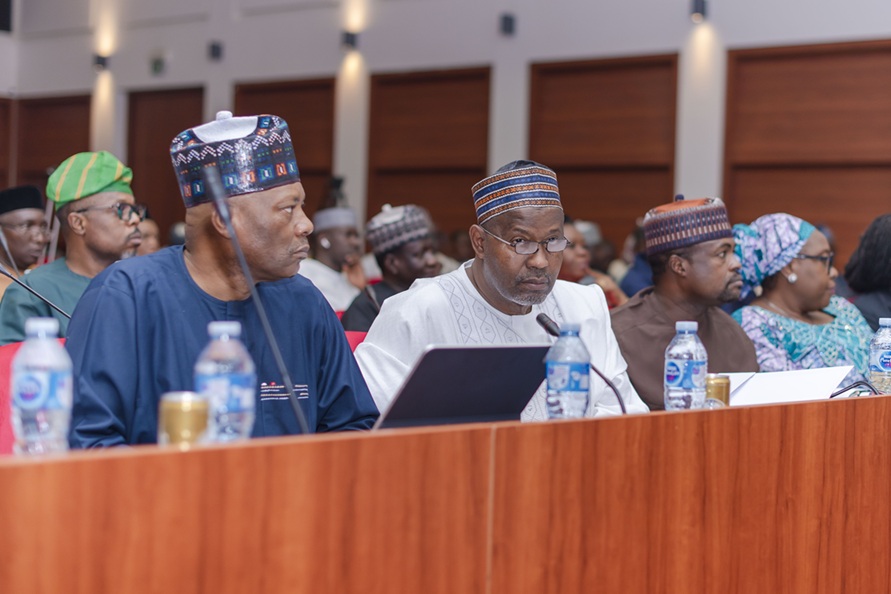
The Chairman Joint Senate and House Committees on Tertiary Institutions and TETFund, Senator Muntari Mohammed Dandutse, who is representing (Katsina South) in the National Assembly, has decried the low performance of the Federal Budget in Nigerian Universities, noting however that this was at the backdrop of the non-release of capital projects for the 2025 budget cycle now rolled over into 2026 Appropriations.
He said this on Thursday, 12th February, 2026, when the Executive Secretary, National Universities Commission (NUC), Professor Abdullahi Yususfu Ribadu, FCVSN, led Vice-Chancellors of Federal Universities, to the defence of their 2026 Budget proposals.
Sen. Danduste stated that the Committee was worried that so many projects were affected by this anomaly, which includes abandonment of critical infrastructures like lecture halls and theatres, non-completion of hostel facilities and delayed digital transformation of facilities at the institutions.
Stressing that while the Committee understood this critical concern, all stakeholders concerned must be ready to review the status of the 2025 budget allocation to ascertain the affected projects, liabilities incurred and severe implementation collapse for the planned roll over.
He also advised that rolled-over projects must not compound the inefficiency, with demand reality and the listed timelines, transparent recapitalisation and credible cash flow planning.
He also mentioned, that critical, was the issue of Internally Generated Revenue (IGR) performance, explaining that universities must strengthen their IGR Projects by targeting financial inflow streams such as consultancies, research commercialisation efforts and government-alumni partnership without compromising access or equity.
The Joint Committee Chairman said they required details of the 2025 IGR Records, growth strength accountability mechanism and efficiency strategy, emphasising that IGR compliments and does not replace government primary responsibilities to fund public education adequately.
He stated that universities 2026 budget must reflect realistic capital planning, clear benchmark, robust monitoring and fiscal discipline, adding that the National Assembly supports all reforms that advances University autonomy, accountability, research excellence and infrastructural renewal.
He said the National Assembly would rigorously pursue its oversight duties, noting that the exercise is collaborative not at cross purposes but a shared university system driving national development.
Senator Danduste urged all Nigerian universities to present factual transparent submissions that were constructively done including measures aimed at improving their budget performances in 2026.
He noted that it was important for the government to pay adequate attention to the universities with the right investments, as they remained key drivers of development and innovations anywhere in the world.
While commending the Executive Secretary, NUC, Professor Ribadu and other governmental institutions for spearheading the removal of the Universities from the Integrated Personnel Payroll Information System (IPPIS) and the recent 40 percent increase in the allowances of the academics which implementation commenced January 2026, he urged the universities to work in partnership with the National Assembly to promote developmental initiatives for the education sector and the nation in general.
In a separate remark, his counterpart in the House of Representatives, Hon. Fulata, observed that little progress would be made if the National Assembly confined its consideration to only the 2025 capital budget as captured in the Order Paper.
He further noted that a similar concern applied to the IGR submissions by the universities, which, according to him, did not capture two-thirds of the required provisions. He stated that members would study the documents in detail and, where necessary, invites the respective universities for further consultations and clarifications.
He identified two fundamental issues that require urgent attention. The first is the abuse and non-compliance with Section 14(3) of the Constitution of the Federal Republic of Nigeria, particularly as it relates to staff recruitment across universities, which in many instances fails to reflect the Federal Character principle. The second concern is the disregard for Section 80 of the Constitution, especially regarding non-compliance with the appropriation of Internally Generated Revenue (IGR).
He expressed concern that university Governing Councils have no legal authority to approve expenditures from IGR that have not been appropriated by the National Assembly, stressing that any infractions identified in a university’s submissions would be addressed on a case-by-case basis.
While presenting the report on NUC’s budget performance for 2025, the Executive Secretary, Professor Abdullahi Yusufu Ribadu, disclosed that the Commission received a total of N147 million as IGR from rent on its facilities in Lagos, and confirmed that a receipt of its remittance into the consolidated Federal Government revenue account has been attached as evidence of 100 percent compliance.
He informed the National Assembly that the NUC is presently understaffed, as many personnel have retired over the past 12 years being the last time recruitment was conducted, leaving the Commission with only 497 staff members to supervise approximately 308 universities nationwide.
He noted that the NUC had obtained waivers from the Federal Ministry of Education, the Office of the Head of Civil Service of the Federation, and the Federal Character Commission to fill 247 existing vacancies, for which over 126,000 applicants had applied across both senior and junior officer cadres.
He added that the recruitment process would commence only after the passage of the 2026 Appropriation Act, to ensure that personnel costs are properly captured in accordance with the Memorandum of Approval issued by the Budget Office of the Federation.
He explained that the NUC also manages third-party funds, such as those generated from resource verifications and the accreditation of university programmes not funded by the Federal Government. These funds are primarily used to cater for resource persons, mostly professors engaged by the Commission, covering their transport and other logistical needs.
He disclosed that the Commission plans to automate its quality assurance system, which will require additional infrastructure, procurement of computer systems and laptops, as well as training in Artificial Intelligence (AI) for back-end staff who will drive the process, making operations more efficient and streamlined.
The Executive Secretary further stated that the NUC has an ICT Blueprint Project with the Agence Française de Développement (AFD), valued at 40 million dollars, to fund special ICT programmes covering infrastructure and training in 10 selected universities, with funds soon to be disbursed.
On the challenges confronting the NUC, Professor Abdullahi Yusufu Ribadu highlighted that many of these issues are perennial. Key among them are meagre overhead costs, which are irregularly released; security concerns; and the Commission’s reliance on a single authority for fund approvals, particularly among Parastatals – factors that often delay access to emergency funds required for operations.
He further noted that non-implementation of the 2025 budget has been a major constraint. On average, performance based on budget releases has been around 30 percent, while some entities failed to meet even this minimal level, with many receiving no releases at all, effectively resulting in zero performance.
Highlighting outstanding issues, the Executive Secretary pointed out that some universities are yet to receive the one-year arrears of the 25 to 35 percent salary increase, a matter that was also raised during the FGN/ASUU renegotiation meeting concluded in December 2025.
He added that with the new agreement in place, careful attention must be given to Personnel Costs to ensure implementation is not stalled by insufficient budgetary provisions. He emphasized that this consideration should extend to NASU and NAAT, whose unions are currently in negotiations with the government, noting that budget estimates should factor in the anticipated increases in personnel costs pending the conclusion of these processes.
He highlighted that some capital projects executed under the 2024 Appropriation in Nigerian universities still have outstanding payments owed to contractors, and urged the National Assembly to intervene in resolving these issues.
He also clarified that certain funds classified as IGR pertain only to specific services, such as charges for student ID cards, examination fees, and hostel fees used for facility maintenance. He noted that it is feasible to track the number of students receiving these services and the amounts charged, providing a clear picture of income and expenditure.
He expressed appreciation to the Federal Government for allowing Nigerian universities to exit the IPPIS, noting that only the Nigerian Army University, Biu, Borno State, remains on the system, and called on Assembly members to facilitate its removal.
The meeting was attended by members of the Senate and House of Representatives Committees, Vice-Chancellors of federal universities, the NUC Director of Human Resources, Mrs. Alishabattu Balogun, the Acting Director of Finance and Accounts, Dr. Zakariya Kwenta, among others.