
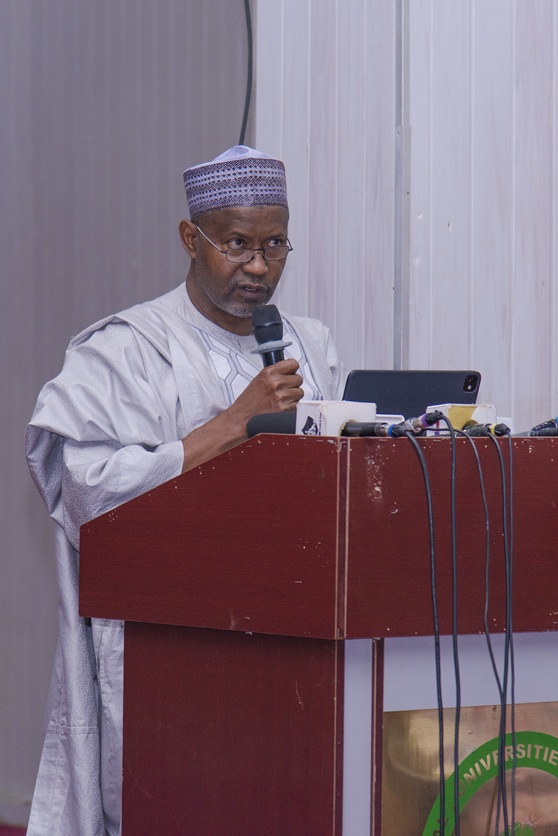
The Executive Secretary, National Universities Commission (NUC), Professor Abdullahi Yusufu Ribadu, FCVSN, on Friday, 5th December, 2025, held an interactive session with the Management and other staff of the Commission, where he reeled out his scorecard in Commemoration of the One-Year Anniversary of his Appointment as 9th Substantive Chief Executive.
In his opening remarks, Professor Ribadu recalled that his appointment was announced by the President and Commander-in-Chief, Armed Forces of the Federal Republic of Nigeria, Asiwaju Bola Ahmed Tinubu, GCFR, on Friday the 6th of December, 2024, while he assumed duties on Monday, the 23rd of December, 2024.
He used the forum to express appreciation to the management and staff for the cooperation and support extended to him in the past one year which had contributed significantly to the progress made based on his seven-point agenda, describing the success as a collective effort of every single staff of the Commission.
The Executive Secretary recounted that on his first day he laid out a seven point strategic goals which will guide his tenure and scorecard after five years as follows: Increasing Access, Enhancing Funding and External Support, Driving Digitisation, Strengthening Quality Assurance, Promoting Innovation and Research, Stabilising the Academic Calendar and Revisiting NUC Laws
Giving a detailed insight on the Key Performance Indicators (KPIs) and deliverables based on each goals set, he highlighted that towards increasing access, the NUC under his watch had expanded the number of Public Universities with the addition of seven new Federal institutions and six state universities, while private universities has increased by 19, within the period.
He further disclosed that 879 new programmes where introduced in the Nigerian Universities based on the recently approved Core Curriculum Minimum Academic Standards (CCMAS), while the Commission attained a landmark achievement with the approval of a Branch Campus under the Trans-National Education (TNE) programme and the addition of two new Distance Learning Centres across the country.
On the Goal of Enhancing Funding and External Support, Professor Ribadu noted that NUC had made effort through its Blueprint for ICT Development Project to strengthen project financing for the NUS by engaging the Federal Ministry of Education and development partners, including AfDB, Islamic Development Bank, World Bank on new funding requests aligned with priority components of the NUC’s Blueprint for the Rapid Revitalisation of University Education.
He stated that Under the Africa Centres of Excellence (ACE) Project, the Commission facilitated the formal closure of the ACE Impact phase, while it opened Engagements with the World Bank, which s currently at an advanced discussions on a follow-up phase (ACE Innovate) – for which the Federal Government is processing a request of $150 million.
He added that the Commission successfully completed preparatory activities and launched the €38 million Blueprint ICT Development Project funded by AFD, culminating in the selection of 10 federal universities and the inauguration of key governance structures to drive the project implementation, stressing that all these are expected to have ripple effect on research output, quality of programmes in the universities and overall national development.
The Executive Secretary also said the Sustainable Procurement Environmental and Social Standards Enhancement (SPESSE) Project has secured a one year extended project cycle up to June 2026, with 60million dollars additional financing being discussed.
While harping on the goal three of driving digitization, the NUC Scribe noted that his commitment is to ensure an electronic NUC (e-NUC) that matches global practice- a transformative digital platform entailed to automate the Commission’s entire workflow through the integration of advanced technologies, which would be deployed soon.
He explained that the e-NUC System is built on a secure, robust, and user-friendly web-based architecture featuring role-based access for all stakeholders (universities inclusive) to perform their assigned functions efficiently, while the Commission looks forward to launching this innovative solution poised to revolutionize the NUS.
He mentioned the benefits of the digitization project to include: Enhancement of Operational Efficiency; Reduction in Operational Costs; Institutional Transparency; Service Delivery; Timely Processing and Accessibility of Data and Generation of accurate reports to support data-driven decision-making and effective policy formulation.
Buttressing on the impact of the digitization process, Professor Ribadu noted that this service will help to enhance Applications for Routine Quality Assurance Visits; Submission of correspondences; NUC Human Resource Platform; Gateway for collaboration, collation, verification, and dissemination of real-time information on universities Programmes, Affiliations,
Staffing profile and Enrolments.
Dwelling on the Goal 4 of Strengthening Quality Assurance, he pointed out that NUC had continued to play this strategic role through the Development/Review of Existing Guidelines & Strategic Documents with the completion of Guidelines on Use of Honorary Degrees in NUS; Approval by management of Benchmark Statements on Student Support Facilities and Services, Manual on Resource Verification, which is Awaiting Management Approval; Ongoing Review of Guidelines Governing on the Establishment and Operations of Private Universities; Ongoing Committee on Streamlining of Affiliations in the NUS; Contributions to the development and critique of draft policies on anti-bullying, disability inclusion and student safety.
He also stated that the Commission recently held Interaction with Professional Bodies on Accreditation of Programmes to ensure harmonization of the quality assurance framework.
Under the goal 5 of Promoting Research and Innovation, the Executive Secretary highlighted that the Commission facilitated the formal closure of the ACE Impact phase and supported the launch of the ACE Alliance, a national platform uniting all 20 Centres.
The Alliance is targeted at providing a platform for all ACE Centers in Nigeria to collaborate further on research relevant to Nigeria’s development, while a 4 volume compendium of research output from ACE Centers was also recently unveiled to put on record their success stories.
Also, the Nigerian Research and Education Network (NgREN) also recorded major progress in its repositioning efforts of research in the NUS, by the integration of TETFund’s TERAS platform. The TERAS comprises of IT Infrastructure and services storage and networking infrastructure with high reliability and availability available to participating institutions.
He said with TERAS, institutional libraries are empowered to squarely address the business of providing support for publication and learning needs of students.
The platform, according to him, is positioned to help researchers by providing a large collection of materials, including journal articles, books, and conference proceedings, often with the most current research available.
On the Goal 6 of Stabilising Academic Calendar, Professor Ribadu gave a cherry news that significant progress has been made regarding current negotiations with University based unions on FGN/ University-Based Unions 2009 Agreements.
He said the Commission sustained its key roles in the re-negotiation process enabling the achievement of some milestones that have persuaded ASUU to recognise Government’s efforts towards meeting their demands, thus creating some measure of stability in the system.
The Executive Secretary outlined part of the recorded successes to include the Commission’s facilitation of: the Payment of arrears of negotiated Earned Academic Allowances (EAA) and Earned Allowances (EA) in the sum of 50 Billion Naira; Mainstreaming of the EAA and EA into the salaries of university workers with effect from 2026; Approval of 150 Billion Naira revitalisation fund and release of 50 Billion Naira of the fund, which is awaiting disbursement as well as the Payment of accumulated promotion arrears in Federal Universities and Release of third-party deductions of the paid withheld salary of university staff due to strike action in 2020.
He mentioned that a National Research Council Bill which was proposed for establishment has received significant attention with progress made, aimed at providing sustainable funding for Research and Development in Nigeria, while efforts are also underway to encourage industries to establish research centres within universities towards the promotion of Industry–University Research Linkages.
On the perennial challenge with the NUC Laws considered obsolete, the NUC Scribe said his Goal 7 is to revisit the laws, with the hope to fast track the Proposed Amendments to the NUC Establishment Act Cap N81 LFN 2004 & Education (National Minimum Standards and Establishment of Institutions) Act Cap E3 LFN 2004.
He expressed delight that the revisit of the law is also priority area of the recently constituted 13th NUC Board, stating that Management is optimistic that this goal will be achieved to reposition the Commission for greater efficiency and productivity.
Professor Ribadu wrapped up the interaction with a presentation of his efforts at improving staff welfare including the refurbishment of staff buses which were in varying state of disrepair by repairing them to improve daily movement for staff and support their welfare.
On the Appointment of Directors, he expressed regrets for the inability of the Commission to fill the vacant leadership positions, remarking that Management is working hard to conclude the processes within the shortest possible period and also conduct other cadre of staff promotions.
In the area of capacity development, he highlighted that five in-house trainings were held in 2025 to improve on the knowledge of the staff on work ethics, financial regulations, curriculum development, ineffective supervision and staff misconduct.
On challenges confronting the NUC, he listed them to include Inadequate Funding, Staffing and Capacity Deficits, Infrastructure and Office Limitations, Legal, Policy and Governance Issues as well as Logistical Challenges.